Two Adams:
The First, a Son of the Earth; the Second, a Son of the Breath
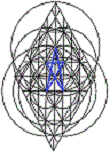
When I first examined Adam Kadmon, my attention fell upon Yesod (Prov. 9:12). I saw within the diagram a symbol of the physical body, with bound feet below (Malkuth) and with arms outstretched above (Hod, Netsach). I saw an image suggestive of the earthly crucifixion of Messiah. Without instruction in the mysteries of kabbalah, I understood, by seeing first the cross of the Jesus of Evangelical American Protestantism, that the symbol belonged to "things Christian," whether or not it was very "Christian" to investigate further.
But look further I did-- higher, as it were: to discover, in the next court, what I took to be the cross of the resurrected Messiah, and which I later came to understand as being representative, also, of the spiritual cross borne by the heavenly Messiah from the foundation of the world (Rev. 13:8). What had appeared from the view below as outstretched arms (Gevurah, Netsach) became as liberated feet above. The new body mass became Tipareth (Beauty), and the new pair of outstretched arms (Din, Chesed) spoke no longer of surrender, but of power. In the two perceptions, I was thereby reminded of the death, burial, and the resurrection of Mashiyach.
Looking two courts higher, I saw a Trinitarian conception (Chokmah, Binah, Kether, and began to understand the meaning of the scripture, "No man cometh to the Father, but by me." I had not yet come to the Father, though he has been always with me (Ps. 139:8), nor yet to any real comprehension of the Unity of the concepts of Father, Son, and Spirit; but I found that my mind was now, somehow, more ordered for the approach. In growing faith that the Son would someday reveal the Unity to me (Deut. 6:4; Matt. 11:27), I turned my attention once again inward, and to those aspects of the sephirot that speak of things familiar-- of the First Adam.
The "Adversary" is that body of thought built by man
in the blinking of an eye within the cocoon of reflective thought
(Acts 17:30).
Love of his own perfection, the sense of entitlement fostered by that
perversion
 of self-awareness, became Lucifer's undoing. Learn what this means, "I will have
mercy and not sacrifice"; for Satan, and the hosts of Amalek fathered by him in his ongoing conjunctions with man's perception of experience,
will be bound in the fullness of time by Y'shúa's prayer, "that they may be One"
(John 17:21).
of self-awareness, became Lucifer's undoing. Learn what this means, "I will have
mercy and not sacrifice"; for Satan, and the hosts of Amalek fathered by him in his ongoing conjunctions with man's perception of experience,
will be bound in the fullness of time by Y'shúa's prayer, "that they may be One"
(John 17:21).
The Second Adam triumphed over the inner adversary (Matt. 4:1-11; Rev. 3:21; Col. 2:15) by reconciling the deceived (Eve, the uncircumcised) and the not deceived (the First Adam, the circumcised): by aligning the flesh in its fallen state with the redeeming will of the Spirit (Eph. 2:11-16; Col. 2:10-13). Y'shúa's earthly walk unto his own mortality in the triumph of his unity with Yahushua, the Angel of the Presence, assures the ultimate salvation of Eve, as the maligned First Adam is a figure of Messiah in Torah, and as Eve is a figure of his bride, the Church (Eph. 5:31-32; Rom. 7:14). United in the hidden faithfulness of the First Adam's death, they shall also be united in the faithfulness apparent in the Second Adam's messianic life (1 Cor. 15:22).
Therefore, in the beginning of mankind's sojourns upon Earth-- before the impact of Eve's separation from Adam at her creation began to assert itself-- before awareness of its significance came by the fruit of the Fall, there was harmony between the flesh and the Spirit (Gen. 2:18, 25). A far greater harmony, magnified in understanding by Truth and in comprehension by Grace (Is. 42:21; Luke l: 46; John 1:17), is restored by Messiah Yahushua in answer to his voluntary sacrifice of self for the building of the inward Temple made without hands (Luke 12:50; Mk. 10:39; John 17).
As, in the beginning, the Breath of Father
Yah
hy emptied
into the processes of creation as Yahushua for the expedience of the
flesh
[Rev. 13:8; Gen. 2:7; 1 Cor. 15:42-45 (verse 46, and following, speaks of the maturation of natural things, as we know that the Spirit predates and inhabits all that appears)], so the man called Mashiyach Y'shúa
(Matt. 1:16)
sacrificed his flesh to give witness
 of ImmanuAL's
coming birth within all mankind
(John 11:50-52; Eph. 2), calling upon everyone to take up their staves-- their crosses,
their bodies and their lives-- and to follow in his steps according to his example.
of ImmanuAL's
coming birth within all mankind
(John 11:50-52; Eph. 2), calling upon everyone to take up their staves-- their crosses,
their bodies and their lives-- and to follow in his steps according to his example.
Furthermore, as the fall of the First Adam is an epic process whose continuing effects are yet evident both in the world at large and also in the Church (Rom. 7; 1 John; 2 Thess.), so is the resurrection of the Complete Adam a greater, countervailing process (Rom. 5.20; 1 Cor. 15:22, 26), whose scope will be fully recognized only in the manifestation of its mature effects (Eph. 4:13; Rom. 8:19).
We therefore conclude that the cross of Messiah-- like the sticks of Ephrayim and Yehudah in the hands of the prophet Yechezkel, a Son of Man-- encompasses the entire history of the human race, with the carnal legacy of the First Adam being crossed and canceled at every point in time by the awesome spiritual legacy of the Second Adam (Rom. 11:22-26), a legacy understood as the Complete, the Perfect Adam.
| First Adam | Second Adam | |
site map map |
t Font a |
book menu menu |