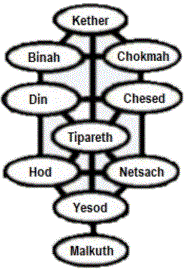
The Sephirot:
Bowls of Spirit
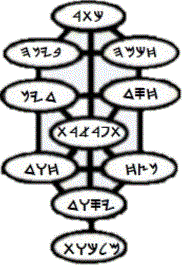
Our examination of the sephirot as they appear in Adam Kadmon will be closer than in their appearances in the Crown Diamond diagram, in which the unity of the spheres is a vital factor, and in which the intricacies of correlation make exposition difficult in these early days of its study on Earth. In Adam Kadmon the foundational facets, or distinctions, of each sphere (1 Cor. 12) are of paramount concern. In the Crown Diamond the collective uniformity as fabric of the Breath is emphasized, by which perspective the many facets combine to display the perfect brilliance of the Foundation Stone (Eph. 4).
If these claims seem a little grandiose, they are nevertheless not far from the every-day reality of the Creation parable of the flesh. Experience teaches us that, though distinct from the eye, the hand can function in one accord with the power of the elohim of sight, as sight in the power of the Elohim of touch: the ability to reach out and examine is common to the Intelligence that controls and utilizes the faculties. The outward differences of the bodily members are among our greatest blessings; for although it is by the distinct delineation of each member that the fullness of Elohim is perceived, it is by the coordinated functioning of all members that the ineffable unity of Elohim is understood.
The sephirot of Adam Kadmon have been given many labels by many students of the scriptures over many centuries, and we affirm the fruit of sincere efforts to understand their meanings. We therefore accept kabbalah-- the "received" tradition-- on the whole, though not always the letter of traditional writings. As for myself, I have particular reservations against those branches of kabbalah that concern themselves with magical applications. Such approaches, if validated by results, nevertheless exalt themselves above the will of hwhy, who can perform wonders without our aid or surrogacy (John 5:30) and has made it quite clear that it is not for us to direct our steps--that is, to concoct agendas for our time on Earth, but to receive the blessings that comes by waiting upon HaShem to lead us in the way we should go.
There are some for whom the term "tradition" will be a stumbling block because of the literal words of Y'shúa and the prophets. However, it wasn't the traditions, themselves, that brought offense, but the manner of observance. To wash cups and such by the Holy Spirit is to wash within, as the cups are understood to be found within; and the sephirot are such cups. To designate something as korban in the Spirit is to know its proper use; for the Holy Spirit dwelling in each of us is able to communicate its use, directly-- both implicitly, as we continue to walk in Ruach HaQodesh, and also explicitly, should we begin to stray from the Spirit's constant and reliable guidance.
Traditional conceptions of the sephirot are scattered throughout the religious writings of time. One interested in mystical kabbalah might well begin with The Zohar ("The Splendor"), which is now available in its entirety in English translation, on the web as well as in print. An excellent primer for historical kabbalah can be found in Encyclopedia Judaica, which is available at most larger libraries. A good overview of basic concepts and approaches can be obtained in the reprint of Dion Fortune's book, The Mystical Qabalah. As every man must witness according to the measure of truth entrusted to him, (Gal. 6:5), this presentation will largely confine itself to those understandings given to its author by HaShem, "who giveth to all men liberally and upbraideth not" (James 1:5).


The sephirot are numbered from One to Ten. Some students begin conscious study of the spheres at Emanation One; others, at Ten; and still others, at Six. My conscious study of the sephirot began with Sphere Nine, which is commonly rendered Yesod, or "Foundation": "For other foundation can no man lay than that is laid, which is Jesus Christ"-- Jesu Christos, Khristos Iesous, Y'shúa haMashiyach: Joshua, son of Nun/None-- son of potentiality, of perpetuity; son of Noon (1 Cor. 3:11): Yah's Shúa: the appearance of the Salvation of hy (Yah/Jah/YH), as proclaimed and manifested by the anointed One of hwhy/Unity (Is. 29:21). Having so begun, I will so proceed. The next page addresses the bias of Christianity, which attended my initial reactions to this imagery.
|
1st and
2nd Man (Illustration) |
 |
Font |
site map map |
book menu menu |
